Transparency | Press | Contact |


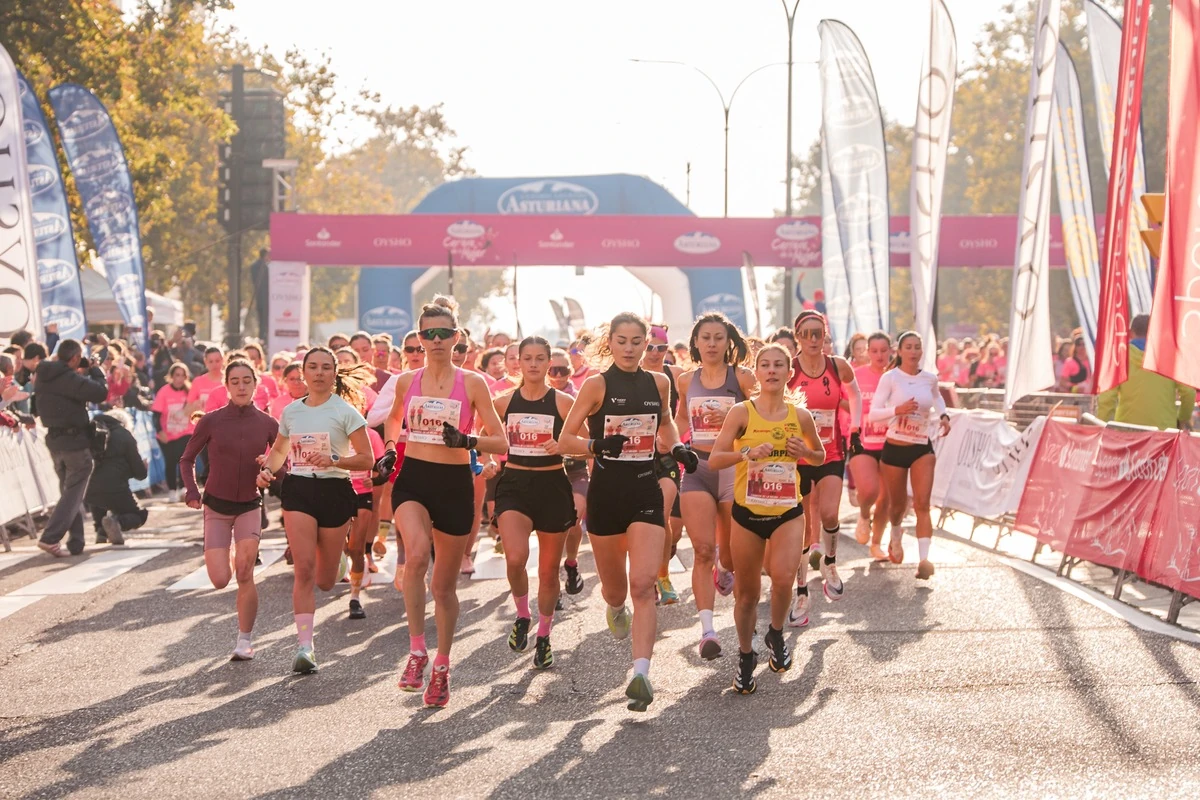
The race sold out all its bibs and this Sunday brought together 17,000 participants who covered 6.5 kilometres through the streets of the Aragonese capital.
The day included a tribute to the athlete Esther Briz and recognition for the Asociación Somos Más, and highlighted the circuit’s commitment to women’s participation in sport.
This Sunday Zaragoza once again became a meeting point for thousands of women who share the same passion: sport. The Carrera de la Mujer Central Lechera Asturiana held a new edition in the Aragonese capital with 17,000 participants and all bibs sold out, a figure that confirms how deeply rooted this event is in the city’s sporting calendar. Regular runners, women facing their first kilometres and participants from different generations shared a morning in which each of them was able to enjoy the 6.5 kilometres in her own way.
The activity began before the first runners set off. At 9:15, the organisers presented a cheque to the Asociación Somos Más, an Aragonese organisation that accompanies and supports women who have survived gender-based violence. Five minutes later, attention turned to Esther Briz, the subject of a tribute with which the Carrera de la Mujer wanted to recognise her sporting career.
Before the start, the participants and the Carrera de la Mujer team held a minute of applause in memory of Carlos Martínez Millet, a colleague from SportLife Ibérica who died in the Urda rail accident, and of all the victims. A shared moment of remembrance and closeness to their families.
From 9:30, the participants began to set off from the extension of avenida Tenor Fleta, divided into four start corrals to help the race run smoothly. With the last starts scheduled until 9:45, the race gave way to a succession of images reflecting the diversity of women who are part of the circuit: some aiming to improve their personal best, others ready to complete the distance for the first time and many sharing kilometres with friends or family.
A 6.5-kilometre route through Zaragoza
From avenida Tenor Fleta, the route went along avenida San José and avenida Cesáreo Alierta to reach paseo de la Mina. The participants then crossed plaza de San Miguel and calle Coso, heading into Zaragoza’s historic centre before making for one of the city’s most recognisable settings: the banks of the river Ebro.
Paseo Echegaray y Caballero led the runners to the Santiago bridge, where they crossed the river to continue along avenida José Atarés. From there, the race tackled its last kilometres towards the Expo area, where the finish line was located, on the esplanade of the Palacio de Congresos, next to the amphitheatre of the Parque del Agua.
A course that connected different parts of the city and allowed women with very different goals and fitness levels to share the route, from those racing with an eye on the clock to those who chose to walk and enjoy the experience in company.
In the competitive race, Isabel Linares was the fastest of this edition and crossed the finish line in a time of 21:09. The overall podium was completed by Marta Ceperuelo and Sara Benedi, second and third respectively, while Lorena Plano and Isabel Macías took fourth and fifth place respectively.
More than two decades promoting women’s sport
The Zaragoza event was the seventh stop of the national circuit of the Carrera de la Mujer Central Lechera Asturiana, which in 2026 visits nine Spanish cities. With more than 22 years of history, more than 150 races held and a total participation of over one and a half million women, the circuit has established itself as one of the leading references for women’s sport in Europe.
Beyond the figures, its history is also explained by the women who, edition after edition, find in these races an opportunity to take up physical activity, get back into the habit of training or share their hobby with other participants.
In Zaragoza, that diversity was reflected once again all along the route. Runners and participants who completed the distance walking side by side allowed women with different abilities, ages and sporting experience to be part of the same race. A formula that makes physical activity more accessible and helps more and more women make sport part of their daily lives.
Social commitment was also present in Zaragoza
Alongside its sporting side, the Carrera de la Mujer has kept up its collaboration with organisations working for women and for different vulnerable groups.
One of the protagonists of this edition was the Asociación Somos Más, which celebrates its tenth anniversary in 2026 and runs initiatives such as its Mentoras-Acompañantes programme, aimed at offering support and accompaniment to women who have survived gender-based violence. The cheque presented before the start served to recognise their work and give visibility to what they do.
The race also had 100% charity bibs in favour of AMAC-GEMA, together with the collaboration of the Fundación Federico Ozanam, through which 25 bibs were provided. Organisations such as the Asociación Española de Cáncer de Mama Metastásico and the Asociación Española Contra el Cáncer, the latter through its regional branch, were also present.
These collaborations are part of the social commitment that has accompanied the circuit since its beginnings and that runs alongside its main goal: encouraging sport and increasing the presence of women in physical activity.
A weekend devoted to physical activity
Sunday’s race rounded off a weekend in which women’s sport also took centre stage off the course.
On Friday 6 and Saturday 7 November, the Palacio de Congresos de Zaragoza hosted the Runners’ Fair, with a programme of free activities that brought different disciplines and training options closer to the participants.
Among them, the highlights were the PilatesFit and Core & Mobility sessions and the activity «Menopause and movement», led by Aoife McGale and Paula Floristán, which focused on the importance of physical exercise during this stage of women’s lives. The programme was completed with options such as Zumba®, STRONG Nation® and CIRCL Mobility™, widening the chances to discover and practise different ways of training.
With the last participants crossing the finish line, Zaragoza thus closed a new edition of the Carrera de la Mujer Central Lechera Asturiana, an event that brought together 17,000 women around sport and that continues to help encourage women’s participation in physical activity.
The circuit now faces its last two stops of the 2026 season: Seville, on 15 November, and Barcelona, on 22 November.
2026 CALENDAR
GRAN CANARIA: 15 March
MADRID: 10 May
VITORIA - GASTEIZ: 31 May
VALENCIA: 7 June
GIJÓN: 21 June
A CORUÑA: 27 September
ZARAGOZA: 8 November
SEVILLA: 15 November
BARCELONA: 22 November